Bri refuses the ghostwritten song and performs a freestyle at The Ring
On the Come UpBrianna refuses the ghostwritten song and performs a freestyle at The Ring in a moment that transforms a planned music-industry showcase into a public claim to authorship. With her father’s stolen pendant displayed by a Crown in the crowd, she stops the backing track, abandons lyrics written by someone else, and speaks to her family, her neighborhood, and the people trying to turn her into a marketable role. The crowd answers with her name; the executives leave. The scene makes artistic independence a consequential choice rather than an abstract ideal: Brianna gives up the approval of her prospective business partners to perform what she believes is hers to say.
Causes and Stakes
The performance follows a struggle over how Brianna should enter the music business. Supreme has urged her to make music beyond The Ring, where battles can attract attention but, as he explains through Dee-Nice’s experience and her father’s career, a successful song can create a route to a record deal. He offers to upload Brianna’s song and call people who might generate buzz. That earlier promise of help establishes the opportunity she may now jeopardize: she is not simply refusing a song, but resisting a commercial plan shaped by other people’s ideas of what will sell.
The immediate dispute sharpens when Supreme presses her to record a song written by Dee-Nice. He presents the decision as business, pointing to James Irving’s money and urging Brianna to take advantage of it. Brianna objects that Hype has already mocked her for supposedly using a ghostwriter; actually performing a song she did not write would make that accusation true. Supreme counters that poverty and food drives are worse than performing material that feels inauthentic, and offers to arrange for people to make her image look more convincing. His argument exposes the bargain he is proposing: accept a manufactured version of herself in exchange for commercial opportunity.
That bargain is entangled with Brianna’s family history. Supreme reveals that her father, Law, had not begun as a gangster; he worked difficult jobs and had been involved with a church choir before Supreme advised him to rap about street life and associate with the Garden Disciples to look authentic. Supreme says Law took the role too seriously, and urges Brianna to perform a part without becoming it. The advice acknowledges a danger while repeating the method that helped produce it. Brianna’s refusal therefore challenges not only a particular song but also the strategy that shaped her father’s public identity.
The Setup at The Ring
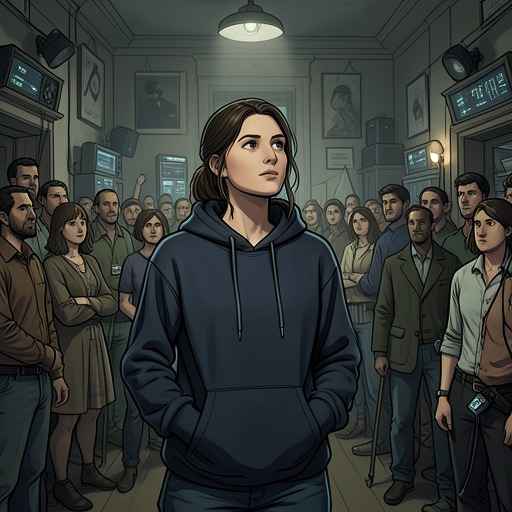
Supreme lifts the ropes so Brianna can enter The Ring and hands her a microphone. The spotlight and the deafening crowd echo her earlier appearance there, but this time the stage carries the pressure of a scheduled release: she is expected to sing the hook and verses Dee-Nice wrote, with Supreme and James watching as if she were performing a trick for them. The planned song is not merely a set of lyrics; in Brianna’s understanding, performing it would make her into the role others have prepared.
The crowd also contains a pointed reminder of violence outside the music business. Brianna spots the Crown in the gray beanie who had targeted her over her father’s chain. He holds Law’s pendant and makes a kissy-face at her while his friends smirk. Scrap notices Brianna looking and silently offers to handle the provocation. The stolen object brings the conflict over her father’s legacy into the room: the pendant is both a visible taunt and a reminder that Brianna’s performance is being watched by people who may read her words through neighborhood rivalries.
As the beat starts, Brianna thinks through what the prescribed song would make her do. She fears reinforcing the Crowns’ and the Maple Grove Garden Disciples’ identities as rival sets, giving her younger brother Jojo more reason to identify with that world, and confirming Hype’s accusation that she speaks words that are not her own. Her change of course grows from these connected stakes. What sounds like a choice between two songs is, to her, a choice between repeating other people’s scripts and addressing what she sees for herself.
Stopping the Track and Taking the Mic
Brianna interrupts the performance before singing the prepared hook: she tells the crowd to stop the music. The beat cuts off, and the interruption produces whispers and murmurs. Supreme frowns; James asks what is happening. Rather than answer them, Brianna tells the audience that she was supposed to perform a new song but would rather do something from her heart, and asks whether that is acceptable. Their loud approval establishes a different audience relationship from the one the executives had envisioned: the crowd gives her room to choose the form and subject of her performance.
Hype offers her a beat, but Brianna declines and insults him, drawing laughter from the room. Then she closes her eyes, gathers the words she hopes Jojo will hear, and begins without instrumental accompaniment. The absence of a beat makes the turn unmistakable: she does not adapt the ghostwritten song or replace it with another prepared track. She takes control of the performance by deciding what to say and how to deliver it.
The freestyle rejects several identities being imposed on her. Brianna refuses to be treated as a joke, as a pet for an audience, as a mouthpiece for gang affiliation, or as a puppet and clone. She names herself as someone’s daughter, sister, hope, and mirror, grounding her public identity in relationships and in the example she may set. She also insists on her intelligence and stardom without accepting the labels of sellout or thug. These claims answer both the commercial packaging around the scheduled song and the assumptions that turn a rapper’s performance into proof of criminal identity.
The lyrics connect those personal refusals to conditions in Garden Heights. Brianna points to children going hungry and hearts hardened by their surroundings, while accusing outsiders of treating violent rap as a convenient image of the community. In her account, those who profit from that image benefit when it is mistaken for the whole truth. She distinguishes describing what she sees from claiming that she herself is the person imagined by the lyrics others expect. Her freestyle also rejects retaliation as another form of separation, urging listeners to wake up rather than treat conflict between sets as destiny. The performance’s central distinction is not between speaking about violence and remaining silent; it is between reporting what she sees in her own voice and being made to perform a stereotype as herself.
Reception and Consequences
The crowd erupts in cheers and chants Brianna’s name. That response supplies immediate public affirmation, but it does not reconcile her with the people controlling the proposed business opportunity. The Crowns do not join the chant. Neither do Supreme nor James: James heads for the door, shaking his head, and Supreme rushes after him. Though Brianna cannot see Supreme’s eyes behind his shades, she reads his expression as an ending between them. Her refusal earns recognition in The Ring while apparently costing her the partnership those men had brought within reach.
That split response gives the event its decisive consequence. Brianna does not measure the success of the freestyle solely by the cheers, nor does she need the executives to approve it. She lowers the microphone and recalls standing before mirrors as a child, using hairbrushes while imagining a crowd chanting her name. The real moment exceeds what she had imagined, not simply because the room is loud but because, for the first time, she knows she is doing what she is meant to do. She says that conviction would remain even if the audience were silent.
The moment also completes a turn in how Brianna understands the promise that first drew her toward hip-hop. Aunt Pooh introduced her to the music, and Nas’s message that the world was hers once seemed like a possibility she could believe in. At The Ring, that possibility becomes a conviction rooted in her own performance. Brianna leaves the prepared song unsung and the business relationship uncertain, but the scene ends with a clearer sense of who controls her voice: she does.